
Union Finance Minister Nirmala Sitharaman on Monday said people are finding current interest rates "very stressful" and urged banks to make them affordable. Speaking at an event organised by State Bank of India, the finance minister said that at present, India requires industry to ramp up and invest in new facilities, and added that lowering lending rates can help achieve the "Viksit Bharat" aspiration.

The panel was set up to suggest ways to reform India's monetary policy.
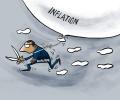
Most members of the Reserve Bank of India's monetary policy committee (MPC) decided to stick to the course on bringing retail inflation to the target of 4 per cent while voting for maintaining status quo in the April review, except external member Jayanth Varma who voted for a 25 bps cut in the repo rate. "I believe that the extant monetary policy setting is well positioned," RBI governor Shaktikanta Das said in the minutes of the policy review, which came out on Friday. "Monetary policy transmission is continuing and inflation expectations of households are also getting further anchored.

The Reserve Bank of India's (RBI) Monetary Policy Committee's (MPC) decision to cut the repo rate by 50 basis points (bps) to 5.5% was contrary to the expectations of many economists. Firstly, most of the economists expected the MPC to cut the repo rate by 25 bps citing the weakening of inflation, prospects of economic growth, geopolitical uncertainty and comfortable system liquidity.

At present, the repo rate acts as the policy rate when liquidity is in deficit mode while reverse repo becomes the operating rate when there liquidity is surplus.
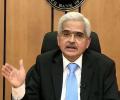
Reserve Bank of India (RBI) Governor Shaktikanta Das has said the decision on interest rate moderation will be based on long-term inflation trajectory and not monthly data. The Monetary Policy Committee (MPC) headed by the RBI Governor is scheduled to meet between October 7 and 9 and take call on interest rate. The RBI kept the repo rate unchanged at 6.5 per cent for the ninth time in a row amid risks from higher food inflation.

Perhaps because the Modi government had some differences of opinion with two of the economist governors (one of whom was appointed by the Manmohan Singh government), there is a view that its political leadership prefers a civil servant to head the RBI, notes A K Bhattacharya.
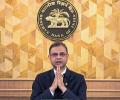
'A repo cut will be very good for the market as it will mean that everything is being done to spur growth in these uncertain times.'
The Reserve Bank is unlikely to ease the benchmark policy rate during 2024 given the uncertainty over food inflation, State Bank of India (SBI) chairman C S Setty has said. The US Federal Reserve's first cut in interest rates in more than four years is expected soon, triggering central banks in other economies to follow suit. "On the rate front, a lot of central banks are taking independent calls.
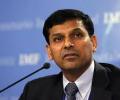
Rajan warned against waiting to act until inflation expectations become entrenched, but also said the Reserve Bank of India would overlook temporary spikes in inflation.

State Bank of India, Tech Mahindra, Larsen & Toubro, Tata Steel, Sun Pharma, Infosys, HCL Tech, Axis Bank, Tata Consultancy Services and NTPC were among the biggest laggards among Sensex shares. Nestle, Hindustan Unilever, Titan, Power Grid, UltraTech Cement and ITC were among the gainers.
The government has invited applications for the post of deputy governor of the Reserve Bank of India (RBI) from interested candidates with at least 25 years of experience and below 60 years of age as on January 15, 2025. One of the deputy governors, Michael Patra's current term will end on 15 January. The last date of submission of applications is November 30, 2024.

Reserve Bank of India (RBI) is unlikely to cut the benchmark interest rate at its upcoming monetary policy review meeting, taking place soon after the announcement of the Lok Sabha election results, amid inflation challenges, said experts. The Monetary Policy Committee (MPC) may also refrain from rate cut as economic growth is picking up, notwithstanding the elevated interest rate of 6.5 per cent (repo) prevailing since February 2023. The meeting of the Reserve Bank Governor Shaktikanta Das headed MPC is scheduled for June 5 to 7.

The RBI on Wednesday slashed key interest rate by 25 basis points, for the second time in a row, to support a shuttering economy hit by reciprocal tariffs imposed by the US. Following the rate cut, the key policy rate eased to 6 per cent providing relief to home, auto and corporate loan borrowers.

Equity benchmark Nifty scaled the psychological milestone of 21,000 in afternoon trade on Friday, and the Sensex touched its all-time intraday high of 69,888.33 after the central bank's decision to keep policy rates unchanged in line with market expectations. The 50-share benchmark index opened on a bullish note, after taking a breather on Thursday, and rose to 21,006.10. As many as 25 stocks were trading in the green, and 24 stocks defied the broader market and were trading in the negative territory.

India's consumer price index (CPI)-based retail inflation rate is likely to have cooled further in June, thus remaining below the 4 per cent target of the Reserve Bank of India (RBI) for a fifth consecutive month, giving the central bank wiggle room to focus on growth. Economists reckon that the decline is on account of easing prices in various categories of goods, especially food items, and a favourable base effect.
'A possible post-election growth momentum may be lost.'

The Reserve Bank of India on Friday decided to keep benchmark interest rate unchanged at 4 per cent but maintained an accommodative stance even as the economy is showing signs of recovery after the second Covid wave.

The three day MPC meeting began on Monday and the decision will be announced on Wednesday by RBI Governor Shaktikanta Das.

Retail inflation declined to a five-month low of 4.85 per cent in March mainly due to cooling food prices, inching towards the Reserve Bank's target of 4 per cent, according to official data released on Friday. The Consumer Price Index (CPI) based retail inflation was 5.09 per cent in February and 5.66 per cent in March 2023. Previously, CPI-based inflation was the lowest at 4.87 per cent in October 2023.

Pressure has been mounting on the Reserve Bank of India to cut interest rates in the wake of declining retail inflation and the need to fuel growth momentum. However, the RBI will have to do a tightrope walk as globally interest rates are inching upwards.
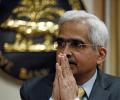
The Reserve Bank of India's rate-setting panel on Wednesday began its three-day deliberations on the next bi-monthly monetary policy amid expectations of at least a 35-basis-point hike in the interest rate to check high inflation. If raised, it will be the third consecutive hike in the repo rate -- the short-term rate at which the RBI lends money to banks. The central bank has already announced to gradually withdraw its accommodative monetary policy stance.

Since Sanjay Malhotra took office as governor in December, the Reserve Bank of India (RBI) has adopted a more accommodative stance, which bodes well for banking and the economy as they navigate a growth slowdown, according to analysts.
Growth remains weak, inflation is within 2-6% range, rate cut would help recoup forex reserves

Reserve Bank of India (RBI) Governor Shaktikanta Das said on Friday said the central bank has developed an innovative artificial intelligence and machine learning (AI/ML) based model MuleHunter.ai to address the growing issue of mule bank accounts that are often used for committing financial fraud. Developed by the Reserve Bank Innovation Hub, the new initiative is piloted with two public sector banks.

A Kotak research report expects RBI to cuts rates by 50 basis points in the first half of 2019. RBI will announce its sixth bi-monthly monetary policy on February 7.

Amid fears of a third wave of coronavirus pandemic and hardening of retail inflation, the Reserve Bank is likely to maintain status quo on interest rate and watch the developing macroeconomic situation for some more time before taking any decisive action on monetary policy. The RBI is scheduled to announce its bi-monthly monetary policy review on August 6 at the end of the three-day meeting -- August 4-6 -- of the Monetary Policy Committee (MPC). The RBI Governor-headed six-member MPC decides on the key policy rates.
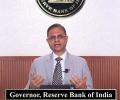
'India has the potential to grow at more than 7%, with the monetary policy providing a supportive hand.'

'The RBI's MPC will maintain the current policy rates (6.50%) at the policy meeting, given ongoing inflationary pressures.'

The Reserve Bank of India on Thursday opted for a pause second time in a row, maintaining key benchmark policy rate at 6.5 per cent as inflation moderates. The rate increase cycle was paused in April after six consecutive rate hikes aggregating to 250 basis points since May 2022. Announcing the bi-monthly monetary policy, RBI Governor Shaktikanta Das said the Monetary Policy Committee (MPC) unanimously decided to keep the rate unchanged at 6.5 per cent.

With retail inflation witnessing significant uptick in May, the Reserve Bank of India (RBI) is likely to maintain status quo in its August monetary policy review, according to a report. According to the SBI's research report- Ecowrap, inflation may remain elevated in the coming months due to several global and domestic factors. "We expect a status-quo in August. We believe RBI would still try to find a marriage of convenience of regulatory and developmental measures and monetary policy in August policy," the research report said on Wednesday.

Titan surged 2.98 per cent, followed by IndusInd Bank, ITC, JSW Steel, Infosys, Tech Mahindra, Tata Consultancy Services and Maruti. Hindustan Unilever, Asian Paints, Bharti Airtel and HDFC Bank were among the laggards.

Reserve Bank of India Governor Shaktikanta Das on Friday said the country's economy is an island of stability despite two Black Swan events and multiple shocks. "In an ocean of high turbulence and uncertainty, Indian economy is an island of macroeconomic and financial stability," Das told reporters during the post policy press conference. He said the financial stability, macroeconomic stability and resilience of growth is being witnessed despite two Black Swan events happening one after the other and multiple shocks.

The Reserve Bank of India (RBI) on Friday hiked repo rate by 50 basis points to 5.90 per cent in order to control the rising inflation, keeping in line with the aggressive policies of central banks and the volatile markets prevalent across economies. RBI Governor Shaktikanta Das announced the rate hike today. In the meeting of the Monetary Policy Committee (MPC) that started on Wednesday, five of the members of the MPC voted to hike the key lending rate, repo rate, by 50-basis points (bps).

Kotak Mahindra Bank was the biggest loser in the Sensex pack, sliding 2.68 per cent, followed by Tech Mahindra, Mahindra & Mahindra, Axis Bank, Hindustan Unilever, Tata Motors, Tata Consultancy Services, Bajaj Finserv, Bajaj Finance, Nestle and Titan. In contrast, NTPC, Power Grid, Larsen & Toubro, HDFC, Reliance and HDFC Bank were the gainers.
The RBI under former governor Shaktikanta Das resisted pressures to cut interest rates through 2024 as it kept its 'Arjuna's eye' trained on inflation, but the central bank under a new detail-oriented head will soon have to take a call if it can continue sacrificing growth. Das, a career bureaucrat who in 2016 oversaw Prime Minister Narendra Modi's highly disruptive demonetisation move, left a lasting legacy as he demitted office towards the end of 2024 after expertly navigating monetary policy for six years, the highlight of which was steering India's recovery through the pandemic.
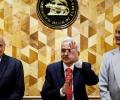
'The central bank has highlighted that the slowdown in growth has been limited to a few sectors and overall growth is expected to pick up in the second half of the year.'

The RBI has doubled the limit of maximum balance that an individual customer can hold with payments banks to Rs 2 lakh from Rs 1 lakh earlier with immediate effect to expand the ability of such lenders to cater to the needs of MSMEs and other businesses.
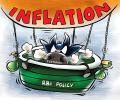
Retail inflation slipped to seven-month low of 3.61 per cent in February mainly due to easing prices of vegetables, eggs, and other protein-rich items, creating space for the RBI to go for another cut in interest rate next month.

With no rate cuts on the table, the other monetary policy alternative could be to reduce the width of the asymmetric policy corridor or increase in reverse repo rate when the pandemic subsides, they opined.
